
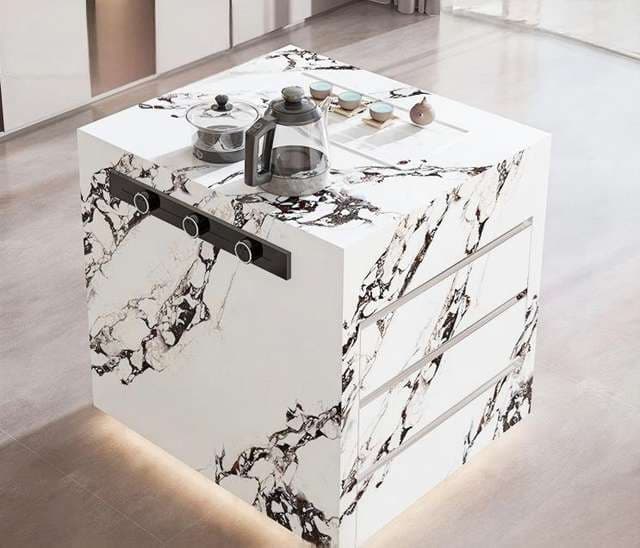
Waterfall Island
A sintered stone island where the top turns down over both ends in one continuous vein, so the slab reads as a single folded surface.
One continuous surface
The top and the two end panels are cut from the same slab and mitred at 45°, so the veining runs unbroken from the worktop to the floor.
Built-up edge
Two 12 mm pieces mitred face to face give a 20–40 mm front edge without the weight of a solid slab.
Made to measure
Any length and depth, with the ends closed or left open.
- Panel
- Sintered stone; quartzite and natural stone on request
- Edge construction
- Top and end panels mitred at 45°, cut from one slab to keep the veining continuous
- Recommended thickness
- Sintered stone 12 mm or 20 mm; natural stone 20 mm or 30 mm
- Visual edge thickness
- A 12 mm slab mitred to give a 20–40 mm front face
- Slab sizes
- 1200 × 2400 mm, 1200 × 2700 mm, 1600 × 3200 mm
- Cabinet
- Storage cabinet with soft-close hardware
- Installation
- Floor-standing. The mitre is glued on both faces, and long spans are reinforced from behind.
- MOQ
- 2–100 m²
The waterfall island takes its name from the way the top turns down at both ends and runs to the floor. Because the top and the two end panels are cut from the same slab and joined at 45°, the veining continues around the corner and down the side.
That continuity is why the waterfall build uses more material than a straight-edged top: the ends take roughly the same area again. It also calls for accurate mitring, and the joint is glued on both faces so it stays closed.
Thickness can be read two ways. A 12 mm slab mitred to a second piece gives a 20–40 mm front edge, which is the usual way to get a substantial look without a heavy solid top. A 20 mm slab is specified where the edge is left as cut, or where the island is built in quartzite or natural stone.
Send us the length, depth and height, tell us which faces should waterfall, and we will lay out the slab so the pattern falls where you want it.